

LWL series horizontal spiral screen filter centrifuge
Date of issue:2020-04-27 Views:715

Main feature
Unmanned operation, continuous operation
The solids remaining on the net after separation and dewatering are continuously discharged to the outside of the machine by spiral blades to achieve unmanned operation and continuous operation;
Excellent dehydration performance
The residual solids on the net are discharged by the spiral blade within about 1 second. Therefore, the solids on the net become thinner, reduce the filtration resistance, and ensure good dehydration performance.
Low power consumption and large processing capacity
In order to reduce the discharge resistance of solid matter, the filter cartridge has a certain inclination angle (dehydration angle). The use of inclined angles and spiral blades reduces solid discharge resistance. It not only greatly improves its emission efficiency, but also has the advantages of low power consumption and large processing capacity.
Compact and compact machine
The assembly that makes up each part makes the machine more compact. Compared to the processing capacity, the machine is small and light. Stable operation even if flow rate and concentration change.
Generally speaking, when the flow rate or concentration changes drastically, the solid layer becomes uneven and vibration occurs. The LWL centrifuge uses the helical rotating blades to forcibly form a uniform solid layer to make the machine run stably.
Net suitable for processing
Through the experience accumulated in production, we provide the most suitable net for various treatments.
Easy to observe dehydration state
Even if the machine is running, the state of separation and dehydration can be observed through the front view mirror.
Special specifications
Special specifications can be customized according to customer requirements.
Application field
Mainly used in adipic acid, thenardite, AH-salt, ammonium persulfate, gypsum, ammonium nitrate, ammonium phosphate, ammonium sulfate, ammonium carbonate, ammonium sulfide, ion exchange resin, sodium chloride, anthracene, sodium chlorate, aspirin , Calcium formate, manganese sulfate, borax, methyl cellulose, sodium metaborate, sodium formate, sodium nitrate, sodium perborate, sodium phosphate, citric acid, sodium sulfate, polystyrene, sodium tetraborate, polystyrene alcohol, large Soda, copper sulfate, potash (potassium carbonate), tartaric acid, crystalline soda, potash, trisodium phosphate, potassium bicarbonate, zinc sulfate, pentaerythritol, plastic granules, glacial acetic acid, potassium chloride, potassium pentasulfide, potassium phosphate , Potassium sulfate.
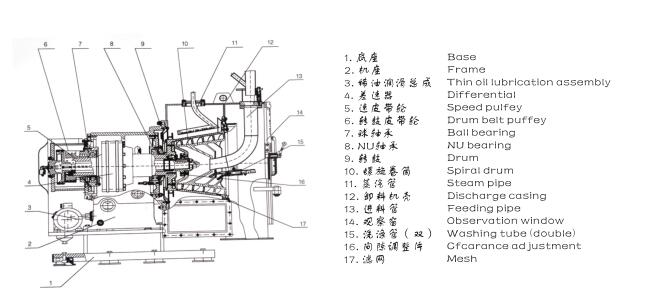
Schematic
Technical Parameters
Model
Feed quantity(m/h)
Power(KW)
Speed
(r/min)
Separtion coneffivent
(fr)
Dimensions
L × w × H(mm)
Weight
(kg)
LWL200
1.5
3
4350
2110
700×880×570
230
LWL250
3.5
5.5
3700
1913
910×1050×800
560
LWL320
7
7.5
3300
1950
940×1165×950
700
LWL350
10
11
2800
1530
1170×1360×1085
900
LWL400
15
15
2900
1880
1150×1500×1150
1000
LWL450
20
22
2500
1570
1390×1500×1315
1100
LWL520
25
30
2200
1406
1480×1920×1470
1800
LWL600
35
37
2200
1623
1560×2000×1470
2000
LWL700
50
55
1800
1400
2150×2100×1650
4000
LWL1000
100
90
1600
1400
2600×2700×2600
8000
